Capillary underground irrigation system with DRAINMAX
A completely new and integrative approach to stormwater management is offered by the innovative underground irrigation system with capillary rise. Similar to the natural water cycle, this system combines infiltration, retention, evaporation and thus cooling, purification and irrigation in a new, unique way.
The innovative stormwater retention and irrigation system stores seepage water from precipitation underground in a two-dimensional retention system. The collected water then rises by itself via the capillary effect without pumping energy. In this way, either green areas are irrigated or the surroundings are cooled by the evaporating water. Due to the resulting high soil moisture, the infiltration capacity of the existing soil is also drastically increased, thus reducing surface runoff in the event of heavy precipitation.
Key advantages of the new technology
- Cooling the environment through evaporation
- Local evaporation creates new precipitation and thus prevents desertification
- Watering the vegetation above the system through capillary rise
- Avoiding flooding through retention
- Replenishing groundwater reserves
- Purification of polluted rainwater
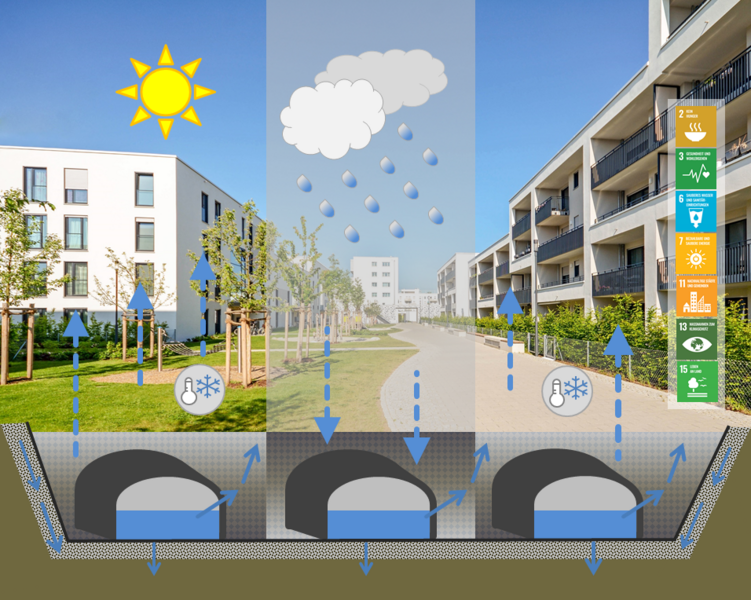
Functionality of the capillary rise
Ideally, the water movement is controlled by the suction tension of the soil, which in turn is created by the suction of the plants. This suction or capillary tension indicates how strongly the stored water is retained in the soil pore. It corresponds to the force that the roots have to exert in order to extract the water from the pore. It thus corresponds to the water retention capacity of the soil or the capillary rise height.
In concrete terms, this means that the smaller the soil pore, the greater the capillary rise and the suction tension. Accordingly, the functionality of the capillary rise in the system under consideration is, on the one hand, dependent on the soil type due to the grain diameter. On the other hand, the capillary rise height is also determined by the degree of soil compaction.
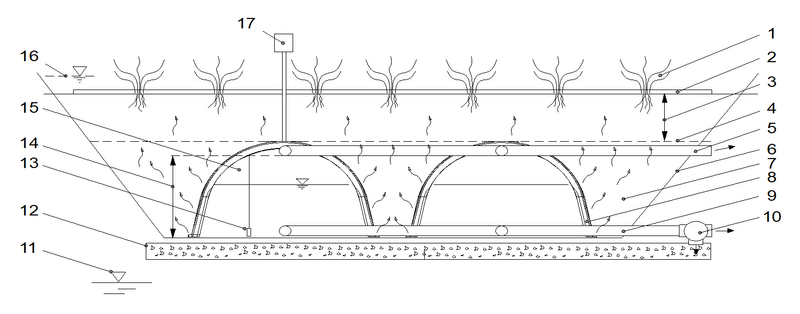
1. Planting 2. Evaporation minimisation 3. Root zone 4. Geotextile 5. Aeration and ventilation 6. Waterproofing, foil 7. Soil zone 8. Water storage elements 9. Drain/ distribution pipes | 10. Drainage organ 11. Groundwater 12. Drainage layer 13. Conductivity sensor 14. Water storage zone 15. Air layer 16. Retention basin 17. Dosing
|
DRAINMAX tunnel trench
Our core stormwater management product consists of 1.6 m³ capacity, plastic trays that create a hollow volume of any size in the soil. It can be used for infiltration, attenuation or storage of water.
- Truck loading capacity and DIBt® approval
- Best price per m³
- Easy installation
- Only system with flushable bottom