Jump directly to main navigation Jump directly to content

Infiltration of treated wastewater

Infiltration of treated wastewater

If the wastewater is treated appropriately in a small wastewater treatment plant, it can be infiltrated decentrally. The DIN technical report CEN/TR 12566-2 and DIN 4261, among others, must be observed here. Depending on the treatment plant process, the treated wastewater enters the infiltration system as a batch or as a constant volume flow. This also determines the calculation of the size of the infiltration system. You can also find information on the calculation at INTEWA Wiki and the INTEWA Online Planner. The DRAINMAX tunnel system is very well suited due to its large side areas open to infiltration. Compared to conventional drainage systems, considerable space can be saved. In addition, a large buffer volume is available for batch operation and further safety. 
The DRAINMAX packages

Planning, delivery and installation in record time!

Use our planning tools to determine the optimal system size in no time at all, then simply select your basic package and the appropriate accessories. Larger systems are coupled.

to the DM packages

System examples

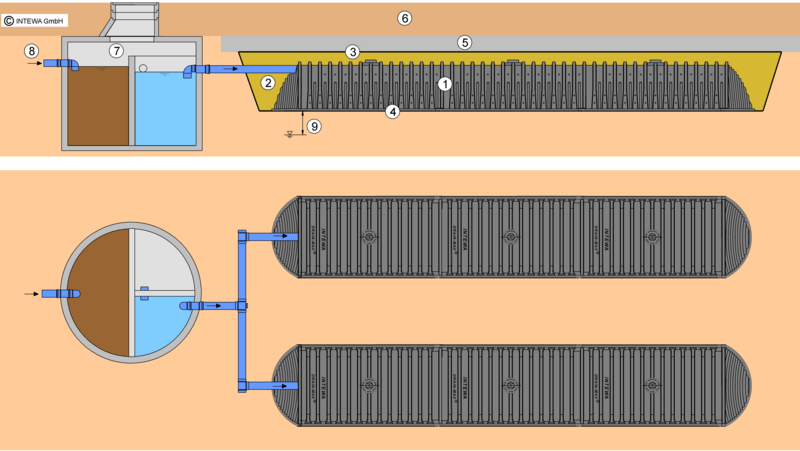
In our tunnel drainage systems, the treated wastewater from a sewage treatment plant is first fed into the sedimentation, filtration, and separation area integrated into the system. Here, the dirt is retained. The water is then buffered in the large-volume tunnels and seeps into the ground from there. They are constructed using DRAINMAX tunnels approved by the German Institute for Building Technology (DIBt) for 60-ton trucks. Installation is quick and easy. The tunnels are installed in a basin on a high-pressure flushable fabric. Compared to other systems, the tunnel system is therefore the only system in which the trench floor can also be cleaned to ensure permanent infiltration capacity. The storage volume is determined by the storage space of the large-volume tunnels and the pore volume of the filling material. This system is particularly cost-efficient in terms of transport, purchase, installation, and operation. The tunnels can be stacked, resulting in very low transport and storage costs and short delivery times. Once I-CONNECT is installed, the system operator can use their browser platform to obtain information about the sludge level and infiltration performance of their system and is immediately notified of any changes via the integrated warning system. With only two different 80 cm high components, consisting of DRAINMAX dome and DRAINMAX tunnel, large-area systems of any size can be created without any connecting elements. The area above the system is available for further use, such as access roads or parking spaces.

Legende

  • Stormwater inlet
  • DRAINMAX tunnel
  • Sedimentation and filterseries
  • Inspection and flushing shaft
  • Ventilation
  • Distribution
  • Geotextil

With our knowledge portal we offer you information about stormwater management, water reuse and more.

Dimensioning of INTEWA products

Planning sheets for various applications

Rainplaner software